
Electrician Marketing Agency in Indianapolis, IN | Bizboxstory
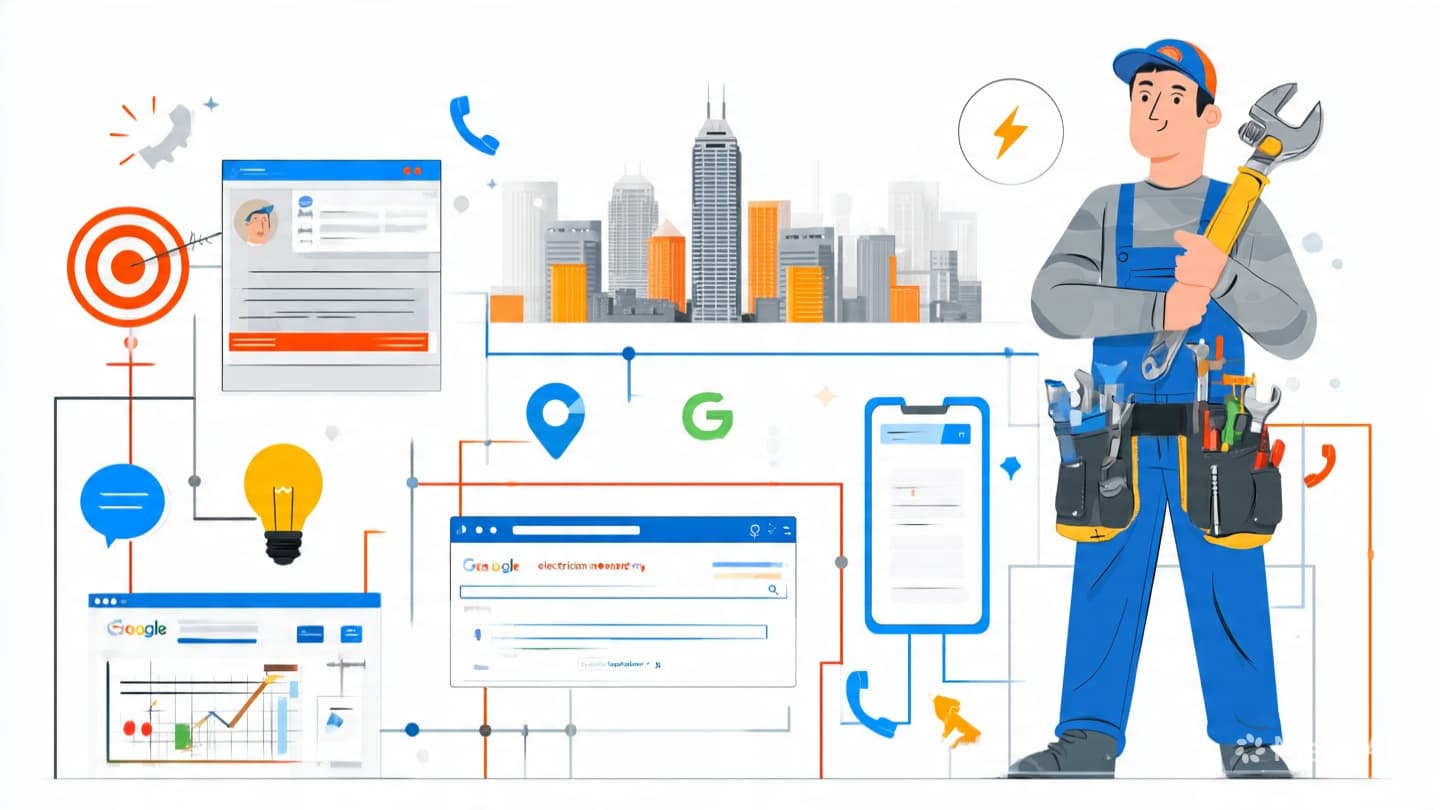
Most marketing advice for electricians reads like it was written for any home service business and relabeled. Post more on Instagram. Get on Google Maps. Ask for reviews. None of that is wrong, exactly — it’s just generic enough to work equally poorly for a plumber, a roofer, and an electrician alike.
Indianapolis electricians have a demand pattern that’s genuinely different, and it’s worth building a marketing strategy around instead of ignoring. A meaningful share of the calls you get aren’t planned purchases at all — they’re triggered by an AES Indiana outage notice, a downed line after a storm, or a homeowner who just found out their damaged weatherhead or meter base is their responsibility to fix, not the utility’s. That’s a different customer, searching under different pressure, than someone quietly researching panel upgrades for a Fishers remodel three weeks out.
This piece looks at what that split actually means for how you market, why the labor and market economics of the electrical trade right now make visibility more valuable than ever, and what a marketing partner should actually be doing for you month to month.
Two Very Different Customers Are Searching for “Electrician Near Me”
Lump every search into one bucket and you’ll market to neither customer well. In practice, Indianapolis electrical demand splits into two distinct paths:
The storm-triggered emergency search. After severe weather knocks out power across Central Indiana, utilities like AES Indiana handle the lines and meters — but repairs to a home’s weatherhead, conduit, and service line anchors are explicitly the homeowner’s responsibility, and that requires a licensed electrician. These searches happen fast, often from a phone, often within hours of the outage, and the searcher has zero brand loyalty. Whoever looks most immediately available and trustworthy wins the call.
The planned, research-driven search. A homeowner in Carmel or Westfield planning a kitchen remodel, adding an EV charger, or upgrading an aging panel before it becomes a problem searches differently — comparing quotes, reading reviews over days, and checking whether a company shows up consistently rather than just once.
A marketing strategy that only accounts for one of these misses real revenue. Storm response needs your Google Business Profile, local pack ranking, and site speed to be flawless, because there’s no time for a slow-loading site to win that customer. Planned work needs content, reviews, and consistent visibility built over weeks, because that customer is comparing.
The Labor Math That Makes Marketing Spend Worth It Right Now
Here’s a number worth sitting with: the electrical trade is short-staffed and getting shorter. Electrician employment is projected to grow 9 percent from 2024 to 2034 with roughly 81,000 openings a year nationally, while one industry analysis projects the available workforce could shrink by around 14 percent by 2030 as experienced electricians retire faster than new ones enter the trade.
What that means for an Indianapolis electrical contractor isn’t abstract — it’s a margin story. Industry data shows service work consistently runs higher gross margins than new-construction bid work, and contractors who shift their business mix toward service calls capture more profit per job, not just more jobs. Marketing that fills your schedule with service and repair work — the exact kind generated by storm response, panel upgrades, and inspections — isn’t just about lead volume. It’s about deliberately building a higher-margin book of business instead of competing purely on bid pricing for new construction.
There’s a second piece to this. The electrical contracting market is heavily fragmented — the vast majority of electrical businesses nationally generate under $2 million in annual revenue, meaning most of your local competitors are exactly your size or smaller. That’s an opening. In a market this fragmented, consistent digital visibility is one of the fastest ways to separate yourself from a competitor running the same truck count as you.
What a Marketing Partner Should Actually Be Doing Month to Month
Skip the service menu for a second. Here’s what should show up in an actual monthly report from an agency working with an Indianapolis electrician:
| What to Check | Good Sign | Warning Sign |
|---|---|---|
| Google Business Profile | Weekly updates, fast review responses, service list matches what you actually offer | Set up once, untouched for months |
| Site speed | Loads in under 2-3 seconds on mobile, especially on service pages | Slow load times on the pages storm-search customers land on |
| Local pack ranking | Tracked separately for emergency terms vs. planned-service terms | One blended “rankings” number with no context |
| Content | Built around real Indianapolis scenarios — panel age, permit requirements, EV charger rebates | Generic “electrical safety tips” posts with no local detail |
| Reviews | Steady flow tied to completed jobs, responded to within 48 hours | Review requests sent in irregular batches, no responses |
| Reporting | Leads and calls tied to specific pages and campaigns | Rankings only, no connection to actual phone activity |
If an agency can’t tell you, without hesitation, how their approach differs for a homeowner calling after a storm versus one planning an EV charger install next month, that’s a real gap — not a nitpick.
Local SEO Built Around How Indianapolis Actually Searches
Neighborhood-specific service pages, not one citywide page. Fishers, Carmel, Westfield, Noblesville, Greenwood, and Broad Ripple each have distinct construction age, housing stock, and search volume. A page written for “electrician Indianapolis” alone leaves search volume from these specific areas on the table.
Emergency-ready Google Business Profile setup. Categories, service list, and posts should make it immediately obvious you handle storm damage and outage-related repairs — including the specific homeowner responsibilities (weatherhead, meter base, service line anchors) that most competitors never mention on their profile at all.
Review requests timed to the job type. A storm-response job and a planned panel upgrade deserve different follow-up messaging — one emphasizes speed and relief, the other emphasizes quality and long-term trust.
Citations and backlinks from sources Indianapolis homeowners already trust — local news coverage of major storm events, home builder associations active in Fishers and Carmel, and Central Indiana contractor directories carry more weight than generic national listing sites.
Seasonal content planning tied to Indiana’s actual weather calendar. Search volume for outage-related repairs and generator installs spikes around severe storm season, while panel upgrades and remodel-driven electrical work cluster around spring and fall permitting cycles. Content and ad budget that flex with this calendar outperform a flat, always-the-same monthly plan.
Where AI Search Fits Into This
When someone asks an AI assistant “who should I call for electrical damage after a storm in Indianapolis,” the response pulls from review signals, structured business information, and content that clearly answers the question — not just a list of links. Electricians who publish clear, specific content about topics like what’s covered by the utility versus the homeowner after an outage, or what a panel upgrade actually costs in Central Indiana, are the ones showing up in those generated answers. Generic “why choose us” pages rarely get cited, because they don’t actually answer a specific question the way a well-structured FAQ or service page does.
The Real Customer Journey, Broken Into Two Timelines
Emergency path (hours, not days): Outage or visible damage occurs → homeowner searches from a phone, often including “near me” or a neighborhood name → scans Google Business Profile for current activity and rating → checks whether the business explicitly mentions storm or emergency service → calls the first business that looks both available and credible.
Planned path (days to weeks): A concern surfaces — an aging panel, a remodel, an EV purchase — → homeowner researches typical costs and process, often reading a blog post or FAQ page before ever visiting a company site → compares 2-3 companies on reviews and range of services → requests quotes → decides based on responsiveness and trust signals built over the research window.
Building for only one of these paths means leaving the other one to a competitor.
Mistakes That Cost Indianapolis Electricians Real Leads
- No storm-specific content or profile signals, so emergency searchers can’t quickly confirm you handle that kind of work
- Treating Fishers, Carmel, and downtown Indianapolis as one audience with identical messaging and pricing expectations
- Letting the Google Business Profile go stale between jobs, which reads as inactive to both customers and Google’s algorithm
- Competing purely on new-construction bid pricing instead of marketing the higher-margin service and repair work that’s actually easier to win with digital visibility
- No connection between marketing reports and actual booked jobs, making it impossible to know if the spend is working
Building Trust Beyond the Website
Digital visibility works better when it’s backed by real local presence:
- Partnering with home builders and remodeling contractors active in Fishers, Carmel, and Westfield creates natural referral relationships that also translate into backlinks and citations
- Sponsoring or showing up at neighborhood association events builds the kind of name recognition that turns into direct, branded searches later
- Getting mentioned in local news coverage of major storm events — even a quote about what homeowners should check after an outage — builds both credibility and a strong local link
Frequently Asked Questions
Do Indianapolis electricians really need a different marketing approach than electricians in other cities? Yes — Central Indiana’s storm and outage patterns create a real emergency-search customer segment that most generic marketing playbooks don’t account for, alongside the planned-purchase customer researching remodels and upgrades.
What’s the difference between marketing for storm response versus planned electrical work? Storm-response marketing depends on Google Business Profile speed, local pack visibility, and fast site load times, while planned-work marketing depends more on content, reviews, and consistent visibility built over the weeks a homeowner spends comparing options.
How much should an Indianapolis electrician budget for marketing? Budgets vary by scope, but the more useful question is what a booked job is worth to your business — since service work typically carries higher margins than new-construction bid work, marketing that fills your schedule with service calls often pays for itself faster than expected.
Is it worth marketing for storm and emergency electrical work specifically? Yes — homeowners are often unaware that repairs to their weatherhead, meter base, or service line anchors are their own responsibility after a utility restores power, which creates real, underserved search demand that most electricians never target directly.
How does AI search change what electricians should publish online? AI tools pull answers from content that directly and clearly answers a specific question, so FAQ-style content about costs, responsibilities, and processes tends to get cited more often than general “about us” pages.
The Bottom Line
Indianapolis electricians competing purely on referrals are leaving two kinds of demand on the table — the homeowner who needs someone right now after a storm, and the one quietly comparing quotes for a panel upgrade three weeks out. A marketing strategy built around both, backed by neighborhood-specific local SEO and a Google Business Profile that’s actually maintained, does more for your business than another round of boosted social posts.
If you want a closer look at how this works in practice, check out BizBoxStory’s SEO services built for local service and trade businesses, browse case studies from other contractor clients, or book a free strategy call to talk through what’s realistic for your specific service area. Also worth a look if you’re weighing paid channels alongside organic growth: our Google Ads and Local Services Ads management and website design services, or get in touch directly with questions before committing to anything.
About Shay Mehta
Founder, CEO & Author, BizBox Story
Shay Mehta is the Founder & CEO of BizBox Story, a digital marketing agency built specifically for US businesses operating in restricted, underserved, and hard-to-market niches — cannabis dispensaries, pest control companies, chiropractic practices, and home services. Under Shay's leadership, BizBox Story's delivery team has taken clients from page three to page one of Google in as little as 60 days, and helped dispensary clients generate $45,000+ in monthly organic revenue with triple-digit traffic growth.
Shay's path into marketing runs through nearly two decades inside the US and Indian financial services industry. Having lived in the United States for 18 years and completed his education at the University of Massachusetts, Shay went on to hold senior leadership roles at two of the largest names in life insurance: serving as National Head at Max New York Life and later as Director at MetLife India. That career — built on disciplined strategy, large-scale client relationships, and navigating heavily regulated markets — gives Shay a rare vantage point on what it actually takes for a business to earn trust and visibility in the US, especially in categories where traditional advertising doors are closed.
Today, Shay channels that experience into building BizBox Story's proof-first, no-lock-in approach to SEO and digital marketing. Shay is also the voice behind @sayitlikeshay, a rapidly growing Instagram account with 50,000+ followers and an exceptionally high engagement rate, where he shares direct, unfiltered takes on current affairs, marketing and sales.