
How Houston Foundation Companies Get Found First
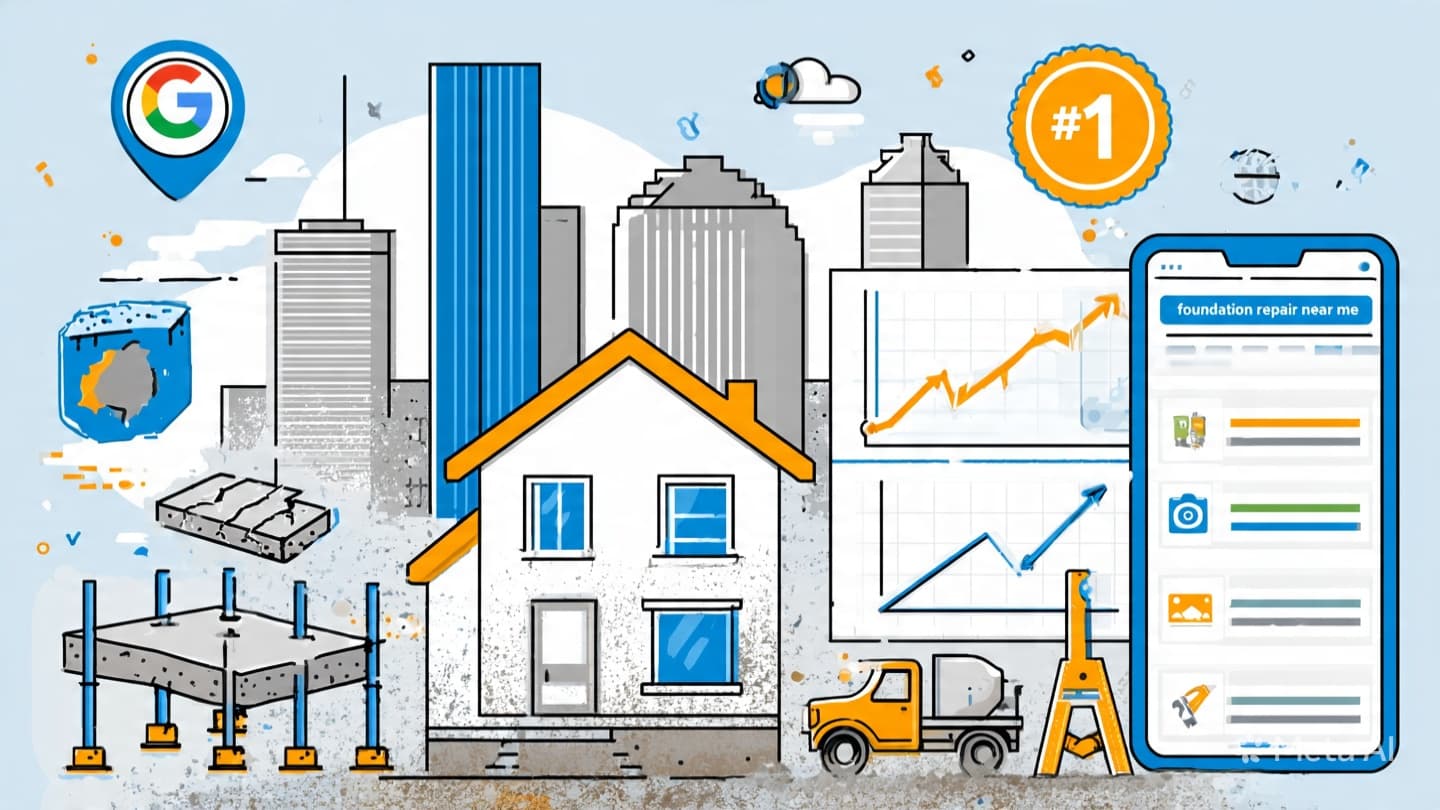
A homeowner in Meyerland doesn’t wake up thinking about marketing funnels. They wake up, notice the bathroom door won’t close right, and by lunch they’ve typed “foundation repair Houston” into their phone. That eight-second decision, made from a kitchen counter or a car in the school pickup line, is the entire ballgame for foundation repair companies in this city. Whoever shows up first, looks credible, and answers fastest usually wins the job.
Foundation repair marketing in Houston isn’t like marketing a landscaping company or a pool builder. The buying trigger is fear, not desire. The competition includes national franchises with seven-figure ad budgets. And the geography itself, thanks to Houston’s soil, works against homeowners in a way that keeps demand constant year-round. Understanding those three realities is what separates a marketing plan that generates real inspection bookings from one that just burns budget.
Houston’s Soil Problem Is Your Company’s Marketing Advantage
Most cities don’t need to explain why foundation repair matters. Houston does the explaining for you, every time it rains hard and then doesn’t rain for six weeks straight.
The Gulf Coast clay under most Houston neighborhoods expands when it’s saturated and contracts hard when it dries out. That cycle repeats every year, sometimes every season, across neighborhoods like Bellaire, Spring Branch, Alief, and Kingwood. Homes built in the 1970s and 80s on shallow pier-and-beam foundations feel it first. Newer slab homes in Cypress and Katy aren’t immune either, especially where builders graded lots quickly during the last building boom.
This matters for marketing because it means your content doesn’t need to convince anyone that foundation problems are real. It needs to help someone who is already worried connect their specific symptom to your company. That’s a fundamentally different job than most home services marketing, and it should shape everything from your homepage headline to your ad copy.
Where Houston Homeowners Actually Look First
Before writing a single blog post, it’s worth being honest about the customer journey. Almost nobody browses foundation repair companies for fun. The typical path looks like this:
- They notice a symptom (sticking door, visible crack, uneven floor)
- They Google it, often adding “is this serious” or “Houston” to the search
- They scan the map results and skim two or three websites
- They check star ratings and read the most recent reviews
- They call the first company that feels credible and available
That whole sequence can happen in under ten minutes. If your Google Business Profile is thin, your reviews are stale, or your website loads slowly on a phone in a driveway with weak signal, you’ve already lost the lead to a competitor who was easier to trust in that window.
Building a Google Business Profile That Wins the Map Pack
For a service this local and this urgent, your Google Business Profile carries more weight than almost anything else you do online. It’s the first thing homeowners see, and it’s what Google leans on to decide who shows up in that three-listing map pack at the top of local results.
A few things separate profiles that consistently rank from ones that don’t:
- Service list precision — don’t just write “foundation repair.” List slab repair, pier and beam leveling, drainage and grading correction, crawl space work, and free inspections as individual services so Google can match you to more specific searches.
- Photo volume and quality — piers going into the ground, before-and-after floor levels, crew trucks on-site. Profiles with real job photos outperform profiles with stock images by a wide margin.
- Service area accuracy — set every Houston-area community you actually serve, not just the metro as a whole. Katy, Sugar Land, The Woodlands, Pearland, and Cypress each function as their own search market.
- Posting rhythm — a profile that gets a new photo or update weekly signals to Google that the business is active, which quietly helps rankings over time.
Our Google Business Profile service is built specifically around this kind of ongoing upkeep, since a profile set up once and abandoned tends to slide backward within a few months.
Neighborhood Pages Beat One Big “Service Area” Page
A single page that says “we serve the greater Houston area” reads like every competitor’s page. What actually ranks and converts is a set of individual pages built around the way Houstonians talk about where they live.
Someone in Meyerland searching for foundation help isn’t thinking about “greater Houston.” They’re thinking about their street, their flood history, their specific soil. A page built for Meyerland can reference the neighborhood’s known drainage challenges. A page for Katy can talk about newer slab construction and grading issues on recently developed lots. A page for The Woodlands can speak to the tree root and moisture dynamics unique to that area’s landscaping.
This kind of neighborhood-specific content does two things at once. It ranks for long-tail searches your competitors are ignoring, and it makes a nervous homeowner feel like you actually understand their specific situation rather than running a generic script.
Reviews Function as Underwriting, Not Just Reputation
Foundation repair sits in a strange category of home services. It’s expensive, it’s hard for a homeowner to evaluate technically, and it often gets tied into a home sale or refinance. That combination means reviews aren’t just social proof here, they function almost like underwriting. A homeowner reads them to decide whether they’re about to hand tens of thousands of dollars to someone they can trust.
A few practical points on review strategy that get overlooked:
- Ask for the review at the moment the crew finishes the walkthrough, not three days later by automated text. Timing matters more than the request itself.
- Respond to every review, but put real effort into the detailed ones. A thoughtful reply to a two-paragraph review signals more to future customers than a generic “thanks!” ever will.
- Recency matters as much as volume. A profile with 200 reviews from three years ago reads worse to both Google and homeowners than one with 40 reviews from the last six months.
Realtors and Inspectors Are an Underused Referral Channel
Digital marketing gets most of the attention, but foundation repair companies in Houston have an offline advantage that’s easy to ignore: real estate transactions. Home sales in this city routinely stall or fall apart over foundation concerns flagged during inspection. That creates a direct, high-trust referral path if you build relationships with home inspectors, real estate agents, and title companies who need a reliable contractor to recommend on tight closing timelines.
This kind of relationship-building doesn’t replace digital marketing, but it compounds with it. A realtor who trusts you will often check your Google reviews before referring a client, which means the online reputation work and the offline relationship work reinforce each other.
What to Publish, and Why Most Foundation Companies Get It Wrong
The common mistake is treating content marketing like a volume game, publishing generic articles about “signs of foundation damage” that could apply to any city in Texas. Generic content doesn’t rank well against local competitors, and it doesn’t build the kind of trust a worried homeowner needs.
The stronger approach is writing a small number of highly specific pages tied to real questions Houston homeowners are actually typing into Google:
| Content Angle | Why It Works |
|---|---|
| “Why does my slab crack every summer in Houston” | Ties directly to the region’s clay-shrink cycle, feels expert and specific |
| “Foundation repair cost in Houston” | High-intent, comparison-stage search that pre-qualifies serious buyers |
| “Do I need foundation repair before selling my Houston home” | Captures the real estate referral audience directly |
| “How hurricane season affects Houston foundations” | Seasonal relevance most competitors never address |
Each of these should end with a clear, low-friction next step: book a free inspection. Not “contact us,” not a generic form. A specific, low-risk offer converts far better with an audience that’s already anxious about cost.
Common Mistakes Houston Foundation Companies Make
A few patterns show up again and again when auditing foundation repair marketing in this city, and most of them are easy to fix once they’re named.
- Competing on price against national franchises. Companies like Olshan and Foundation Repair of Texas can outspend almost any local business on paid ads. Trying to out-bid them on Google Ads for broad terms like “foundation repair Houston” usually burns budget fast. Local companies win by out-trusting them instead, through reviews, neighborhood specificity, and faster response times.
- Treating the website like a brochure. A static page listing services with no local detail, no recent job photos, and no clear next step reads as generic to both homeowners and Google. It’s the digital equivalent of a truck with no signage.
- Ignoring the gap between emergency and planned repairs. Some homeowners are calling because a door won’t shut today. Others are researching ahead of a planned renovation or home sale, weeks out. A single generic contact form serves neither well. Emergency-minded visitors need a phone number and a fast response promise front and center; planned-repair visitors respond better to educational content and a lower-pressure inspection offer.
- Letting the Google Business Profile go stale. A profile set up once during launch and never touched again slowly loses ground to competitors posting weekly updates and fresh photos, even if the underlying business hasn’t changed at all.
Preparing for How People Search With AI Assistants
A growing share of homeworkers now ask ChatGPT, Gemini, or Perplexity questions like “who does reliable foundation repair in Houston” before they ever open Google. These tools tend to pull from the same signals that already matter for local SEO: a complete, active Google Business Profile, consistent business information across the web, and content that clearly answers specific questions in plain language.
The practical takeaway is that you don’t need a separate strategy for AI search. You need to do the fundamentals well enough that both Google and AI assistants have clean, consistent, well-structured information to pull from. Companies investing in solid local SEO now are positioning themselves for this shift without extra work later.
Keep Your Business Information Identical Everywhere
This part isn’t glamorous, but it’s foundational in the literal sense. Your business name, address, and phone number need to match exactly across your website, your Google profile, Yelp, Angi, and every directory that lists you. Even small inconsistencies, like “Street” on one listing and “St.” on another, can quietly undermine how confidently Google ranks you and how much homeowners trust what they’re seeing.
Pick one exact format and use it everywhere, permanently. It’s a small detail that pays off in both trust and rankings over time.
Timing Campaigns Around Houston’s Wet-Dry Cycle
Houston’s foundation problems don’t distribute evenly across the calendar, and neither should your marketing spend. The clay shrinks hardest during the long, dry stretches of late summer, which is often when cracks and door misalignment become impossible to ignore. Hurricane season brings a different wave of concern, as heavy rain events saturate soil quickly after a dry period, creating rapid shifts that homeowners notice almost immediately.
Building modest paid ad pushes around these windows, rather than running flat budgets year-round, tends to produce a better cost per lead. Organic search and reviews carry the business through quieter months, while ads pick up the slack during the seasonal spikes when search volume genuinely surges.
How BizBox Story Supports Houston Foundation Repair Companies
Running inspections and repair crews all day doesn’t leave much room to manage a Google profile, write neighborhood pages, or chase down reviews. That’s the gap BizBox Story fills for home services businesses, including several in competitive, trust-sensitive categories.
The work is straightforward: build out and maintain a complete Google Business Profile, run structured review campaigns, write local pages for the specific areas a company serves, and keep business details consistent across every listing. For HighThere, a client in a similarly competitive local market, that approach helped grow organic traffic enough to generate more than $45,000 in monthly organic revenue. You can see the full breakdown, along with other results, on the case studies page.
Founder Shay Mehta takes client calls directly rather than routing everything through account managers, and the agency works month to month with no long-term lock-in, so results can be evaluated honestly before committing further. If you’re weighing where to start, the SEO services page and website design services are both good starting points depending on whether your foundation is a slow-loading site or an underdeveloped profile.
A Realistic Starting Order
Foundation repair companies don’t need to overhaul everything at once. A sensible sequence looks like this:
- Fully complete and verify the Google Business Profile, including every service offered
- Upload real job photos, aiming for at least 25 to 30 clear before-and-after shots
- Set up a consistent review request process tied to job completion, not a delayed automated message
- Build individual pages for the top five or six Houston-area neighborhoods served
- Audit and correct business name, address, and phone details across every directory
- Publish one genuinely local, question-driven article each month
Each step compounds on the last. A strong profile makes reviews more visible. Reviews make neighborhood pages more persuasive. Neighborhood pages make the whole site feel like it belongs to a company that actually knows Houston, not one running the same template used in a dozen other cities.
Why This Work Pays Off Longer Than It Costs
Houston’s soil isn’t going to stop moving, and that means demand for foundation repair isn’t going anywhere either. The companies that win consistently aren’t necessarily the ones spending the most on ads. They’re the ones a worried homeowner can find in under a minute, trust within the first thirty seconds on the page, and reach with a single tap to book an inspection.
Get the fundamentals right, keep them current, and the calls tend to follow on their own.
Ready to build a marketing plan around how Houston homeowners actually search? Book a free strategy call with BizBox Story and get a straight answer on where your current marketing is leaving leads on the table.
Frequently Asked Questions
How much does foundation repair marketing cost in Houston?
Most companies start with Google Business Profile optimization and review generation, which is largely a time investment rather than a media spend. Adding local content and a managed SEO plan typically runs a few hundred to a couple thousand dollars a month, depending on how many neighborhoods and services need coverage.
How quickly will a foundation repair company see new leads?
Profile and review improvements can shift call volume within a few weeks. Rankings built through content and local SEO tend to take three to six months to fully mature, but they keep compounding well beyond that window.
Is a website necessary if the Google Business Profile is already strong?
Yes. The profile gets a homeowner’s attention, but the website is what closes the trust gap, showing service details, real job photos, and the specific neighborhoods served. Most homeowners check both before calling.
What’s the fastest way to improve local rankings in a specific Houston neighborhood?
Build a dedicated page for that neighborhood with real, specific detail about local soil and drainage conditions, then support it with recent reviews from customers in that same area.
Should a foundation repair company run Google Ads or focus on SEO first?
Ads generate leads immediately but stop the moment the budget stops. SEO takes longer to build but keeps producing leads at a lower cost per lead over time. Many Houston companies use SEO as the foundation and layer in ads during the hurricane season and late-summer drought spikes when search volume rises fastest.
About Shay Mehta
Founder, CEO & Author, BizBox Story
Shay Mehta is the Founder & CEO of BizBox Story, a digital marketing agency built specifically for US businesses operating in restricted, underserved, and hard-to-market niches — cannabis dispensaries, pest control companies, chiropractic practices, and home services. Under Shay's leadership, BizBox Story's delivery team has taken clients from page three to page one of Google in as little as 60 days, and helped dispensary clients generate $45,000+ in monthly organic revenue with triple-digit traffic growth.
Shay's path into marketing runs through nearly two decades inside the US and Indian financial services industry. Having lived in the United States for 18 years and completed his education at the University of Massachusetts, Shay went on to hold senior leadership roles at two of the largest names in life insurance: serving as National Head at Max New York Life and later as Director at MetLife India. That career — built on disciplined strategy, large-scale client relationships, and navigating heavily regulated markets — gives Shay a rare vantage point on what it actually takes for a business to earn trust and visibility in the US, especially in categories where traditional advertising doors are closed.
Today, Shay channels that experience into building BizBox Story's proof-first, no-lock-in approach to SEO and digital marketing. Shay is also the voice behind @sayitlikeshay, a rapidly growing Instagram account with 50,000+ followers and an exceptionally high engagement rate, where he shares direct, unfiltered takes on current affairs, marketing and sales.