
Why your service business is losing money by ignoring digital marketing
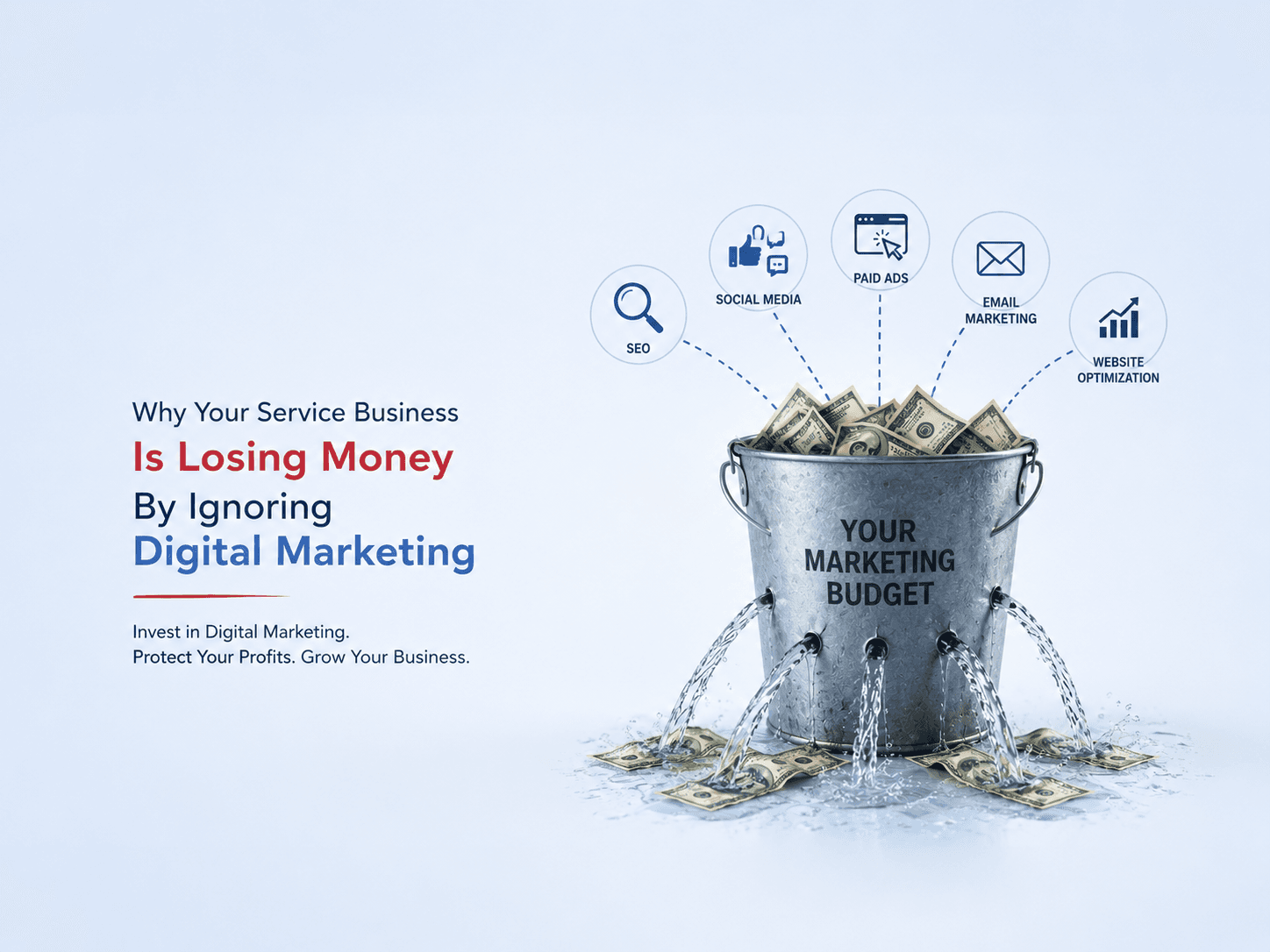
Most service businesses — plumbers, pest control, lawyers, consultants, clinics, agencies, chiropractors, cannabis dispensaries — still put the bulk of their marketing dollars into flyers, word of mouth, and local print ads. But here is the hard truth: if you are not spending at least 20% of your digital marketing budget for service businesses online, you are handing customers to your competitors every single day.
The data backs this up. In 2024, 77.7% of U.S. ad spend went to digital channels. Only 22.3% went to offline channels. The shift is not coming — it has already happened. And yet, a large number of local service providers are still acting like it is 2005.
This article breaks down the real cost difference between offline and online marketing, explains the reach gap, and gives you 10 honest reasons why service businesses are still dragging their feet on digital — along with why that has to change.
Offline vs. online marketing: what does each actually cost?
Before diving into the reasons, it helps to understand what you are actually comparing when you put offline and online marketing side by side.
What offline marketing costs a service business
Traditional marketing includes print ads, direct mail, billboards, flyers, local TV or radio spots, and sponsored events. These channels carry real costs with limited measurement. A half-page ad in a local newspaper can run $500 to $3,000 per insertion. A local radio spot can cost $200 to $5,000 per week. Direct mail campaigns typically run $0.30 to $10 per piece, all in. And once that flyer is printed or that ad slot airs, you cannot change the message, retarget, or track who responded.
Statista projects offline marketing spending in the U.S. will reach $180.5 billion in 2025 — a 5.5% dip from the $191 billion spent in 2024. The decline is slow but steady, and it reflects a market-wide recognition that offline channels are becoming less efficient.
What online marketing costs — and returns
Online marketing includes your website, SEO, Google Ads, Meta ads, email marketing, social media content, and performance campaigns. The entry cost is far lower, and the targeting is surgical. A small business can start Google Ads for as little as $10 a day. Social media management can run $300 to $1,500 per month for a local service business. SEO campaigns typically range from $500 to $2,000 per month depending on competitiveness.
But here is what makes online worth it — the return. A well-executed SEO campaign can yield a median ROI of approximately 748%, meaning roughly $7.48 back for every $1 spent, with some sectors reporting ROI over 900–1,100% in 2025. Email marketing averages $36 to $42 in revenue for every $1 spent. These are not theoretical numbers — they are industry benchmarks.
The reach gap between offline and online marketing
Offline marketing reaches people who happen to be in the right place at the right time. A billboard works if someone drives past it. A flyer works if someone picks it up and does not throw it away immediately.
Online marketing reaches people when they are actively looking for what you offer. When someone searches “emergency plumber near me” at 11 PM, no flyer is going to help them find you. Only a strong Google Business Profile, a fast website, and local SEO will.
Over 51% of small businesses plan to invest more in both social media ads and content marketing, while 47% plan to increase their spending on search advertising and video marketing in 2025. The businesses seeing growth are the ones making this shift. The ones staying flat are often those still relying on word of mouth alone.
10 reasons service businesses are not spending enough on digital marketing
This is the part most marketing articles skip. They tell you what to do but not why you are not doing it. Here are the real reasons — and a hard look at each one.
1. They believe referrals are enough
Word of mouth is powerful. But it is also unpredictable, unscalable, and invisible to anyone outside your existing network. Referrals cannot fill a slow quarter. A well-run Google Ads campaign can.
2. They do not trust the ROI
Many service business owners have tried “digital” once, got burned by a bad agency or a poorly run campaign, and decided it does not work. The problem was rarely the channel — it was the execution. Companies that do not plan to invest in digital marketing are likely unaware of the real benefits and risk losing out on valuable channels for customer acquisition, retention, and engagement.
3. They think a website is enough
Having a website and doing digital marketing are not the same thing. A website with no SEO, no traffic strategy, and no conversion optimization is a digital brochure nobody reads. It needs to be found, and that requires ongoing investment.
4. They cannot measure it — or think they cannot
This is one of the most common objections. But digital marketing is the most measurable form of marketing that has ever existed. You can see exactly how many people clicked, called, filled out a form, or made a purchase. Compare that to a radio ad, where you are guessing based on listener estimates. Offline methods rely on estimates or customer surveys, making ROI calculation far more complex than digital tracking.
5. They are too busy running the business
Service businesses — especially small ones — often have the owner doing everything. Marketing gets pushed to the bottom because there are clients to serve, invoices to send, and staff to manage. This is understandable, but it is also a growth trap. The businesses that consistently invest in their digital marketing budget for service businesses are the ones that stop trading time for money.
6. They are afraid of the learning curve
SEO, Google Ads, Meta campaigns, analytics — it sounds like a lot. And honestly, it is, if you try to learn everything yourself. But you do not have to. Hiring the right agency or specialist is often cheaper per lead than any traditional channel you are currently using.
7. They see digital as optional, not essential
Some service businesses still think digital marketing is a nice-to-have. This view is increasingly dangerous. In 2024, businesses on average allocate 53.4% of their marketing spend to digital channels, with the remaining 46.6% supporting traditional avenues like print, TV, and radio. Your competitors are already there. If you are not, you are invisible to a growing segment of your market.
8. They set it and forget it
Many businesses do invest in digital once — they build a website, run a Facebook ad for a month, or post a few times on Instagram — and then stop. Digital marketing requires consistency. SEO takes months to compound. Social media needs regular content. Performance ads need ongoing optimization. Treating digital like a one-time task is why it fails.
9. They do not know how to allocate the budget
A common question is: how do I split my budget across SEO, ads, social, and my website? Without a framework, it feels overwhelming, so many owners do nothing. The U.S. Small Business Administration and firms like Gartner and Deloitte recommend allocating 5 to 15% of total revenue to marketing overall, with digital taking the majority share. Within a typical digital marketing budget, search engine marketing commands 25 to 30%, content marketing and SEO get 20 to 25%, and social media advertising claims 15 to 20% for B2C businesses.
10. They underestimate how many customers start online
This is perhaps the biggest blind spot. A customer may come through referral — but they still checked your Google reviews, your website, and your social media before they called. If what they found was outdated, missing, or unprofessional, that referral may have quietly gone somewhere else. Your digital presence is your reputation audit trail, whether you are managing it or not.
How Biz Box Story helps service businesses close the digital gap
One company that understands this challenge from both sides of the globe is Biz Box Story. Operating across the USA, UK, Australia, and India, Biz Box Story works specifically with SMEs and startups that have tried digital marketing before and got nothing for it. Their focus is not on follower counts or vanity metrics — it is on revenue and measurable growth. From AI-powered SEO and Google Ads management to social media, content strategy, and website design, they function as a full-stack digital growth team. For service businesses that have budget but no clear direction, or a direction but no execution, Biz Box Story bridges both gaps. Their track record across 50+ brands scaled globally makes them a strong partner for service businesses ready to finally take digital seriously.
What a 20% digital marketing budget actually looks like in practice
Say your service business brings in $250,000 in annual revenue and you spend 10% on marketing — that is $25,000. Twenty percent of that marketing budget going to digital means $5,000 a year, or roughly $417 a month. That is enough to run a basic SEO campaign, maintain an active social presence, and test a small Google Ads spend.
Nearly 40% of small businesses are planning to increase their marketing budgets in 2026, with the majority doing so to drive more leads and sales. If you are in the 54% holding budgets flat, the gap between you and your growing competitors is widening every month.
The minimum viable digital marketing budget for service businesses is not a huge number. It is a commitment to showing up consistently where your customers are already looking.
Frequently asked questions
How much should a service business spend on digital marketing? Most experts recommend spending 5 to 15% of your total revenue on marketing. Of that budget, at least 50 to 70% should go toward digital channels including SEO, paid search, social media, and email. For growth-stage businesses, that percentage can go higher.
Is online marketing really better than offline marketing for service businesses? For most service businesses, online marketing offers better targeting, lower cost per lead, and measurable returns. Offline methods like direct mail or local events still have value for brand awareness, but they should supplement a strong digital foundation — not replace it.
How long does it take to see results from digital marketing? Paid ads like Google Ads can show results within days. SEO typically takes 3 to 6 months to show meaningful traction and 6 to 12 months to deliver consistent leads. Social media builds over time with consistent content. Starting sooner always means compounding returns earlier.
What is the most cost-effective digital channel for a service business? SEO and email marketing consistently deliver the highest long-term ROI. Google Ads delivers faster results and works well for high-intent searches. For service businesses with a local focus, Google Business Profile optimization paired with local SEO is often the single highest-ROI starting point.
Do I need a big budget to start digital marketing? No. You can start with as little as $300 to $500 per month across a basic SEO plan, a maintained Google Business Profile, and organic social media. The key is consistency over a period of months, not a one-time spend. As returns come in, reinvesting a portion of them into paid channels accelerates growth significantly.
About Shay Mehta
Founder, CEO & Author, BizBox Story
Shay Mehta is the Founder & CEO of BizBox Story, a digital marketing agency built specifically for US businesses operating in restricted, underserved, and hard-to-market niches — cannabis dispensaries, pest control companies, chiropractic practices, and home services. Under Shay's leadership, BizBox Story's delivery team has taken clients from page three to page one of Google in as little as 60 days, and helped dispensary clients generate $45,000+ in monthly organic revenue with triple-digit traffic growth.
Shay's path into marketing runs through nearly two decades inside the US and Indian financial services industry. Having lived in the United States for 18 years and completed his education at the University of Massachusetts, Shay went on to hold senior leadership roles at two of the largest names in life insurance: serving as National Head at Max New York Life and later as Director at MetLife India. That career — built on disciplined strategy, large-scale client relationships, and navigating heavily regulated markets — gives Shay a rare vantage point on what it actually takes for a business to earn trust and visibility in the US, especially in categories where traditional advertising doors are closed.
Today, Shay channels that experience into building BizBox Story's proof-first, no-lock-in approach to SEO and digital marketing. Shay is also the voice behind @sayitlikeshay, a rapidly growing Instagram account with 50,000+ followers and an exceptionally high engagement rate, where he shares direct, unfiltered takes on current affairs, marketing and sales.